Customized Dental Implant Abutments: A Simplified Approach to Enhance Esthetic and Soft Tissue Profile- Aseries of Case Reports.
Department of Prosthodontics, K.D Dental College & Hospital, Mathura, U.P, India
INTRODUCTION
The achievement of an esthetic implant-supported restoration is a constant challenge to restorative dentists .Being functionally useful is the similarity between a natural tooth and endosteal dentalimplants, as they have to emerge into the oral cavity after piercing the oral mucosa. Because of the circular shape of the implant and its smaller diameter, when compared with the root of a natural tooth, a dilemma inevitably occurs of how to construct an artificial crownand abutment system that imitates the natural tooth form. The multiplicity and sophistication in the field of prosthetic elements in implantology allow the practitioner to make a choice appropriate to the clinical particularities of each case.
A dental implant is made up of three parts, the crown, thedental abutment, and the implant. The majority of dental implants are designed to be placed into holes drilled in the bone and are thus axisymmetric. The implant may either be of a multi-part design, which is intended to be buried while osseointegration occurs, or a single-part design, which will penetrate the mucosa from the time of placement.
The implant success depends on the prosthetic phase as on the surgical phase. The number & variety of abutments available have direct result on orientation of the implant to the occlusal plane to facilitate prosthetic therapy. By definition, abutment is a metal piece that connects to the implant through an abutment screw. Ideally, implants should be placed parallel to each other and to adjacent teeth and be aligned vertically with axial forces. However, achieving this may not be possible owing to deficiencies in the ridge’s anatomy. To compensate for ridge topography the clinician can enhance placement of implants: augment the ridge, change the intended location of an implant or insert an implant with an
angled trajectory. Different abutments are available for different prosthetic applications regarding Implant position & angulation to allow optimal esthetics.
ABUTMENT
It is made of titanium. It is available in different sizes : 3, 4, 5.5, 7, 8.5 & 10mm in length. Each abutment cylinder size has corresponding abutment screw for use with that particular size. Its components are Abutment cylinder, Abutment screw and “O” – ring.
CLASSIFICATION OF ABUTMENTS
Based on rotational device :
- One piece abutment (no anti-rotational device)
- Two piece abutment (with anti-rotational device)
According to form obtained from manufacturer :
- Machined form
- Custom cast using gold or plastic components
According to method by which prosthesis or superstructure is retained to abutment :
- Screw retention – uses screw
- Cement retention - uses dental cement
- Attachment – uses attachment device
Each of 3 types further classified into :
Straight or Angled (axial relation between implant body & abutment).further angled abutments are elaborated on the basis of their use as follows:-
- Cad-Cam milled structures for individual prosthesis can be angulated upto 30°.
- 6° is indicated for over dentures and bridges.
- For Immediate provisional prostheses Angulation upto 20°.
- 25° for narrow platforms and 28° for the rest of platforms.
ADVANTAGES OF ANGULATED IMPLANTS
- Facilitates placement of an implant with greater dimensions in width and height,
- Permits a greater number of patients to be treated because the procedure is not as restrictive as that used with straight implant abutments,
- Avoids guided bone regeneration (GBR) procedures, allowing circumferential insertion of implants into easier execution of procedures,
- Reduced fees and reduced treatment time.
ABUTMENT SE LECTION CRITERIA
An ideal abutment should lock into the implant with anti-rotational features and transmit the masticatory load within the confines of the implant body. The following pre-requisites for optimum abutment selection should be as follows:
- Long-term stability
- Accurate fit of the components to prevent loosening during function
- Biocompatibility
- Esthetics
METHODS FOR CONSTRUCTING IMPLANT PROSTHESES
Two traditional approaches are available for implant abutment and framework construction, namely, stock abutments and the lost wax/ casting approach. Stock abutments are provided by all the implant suppliers and are milled in a similar way to an implant fixture. The available materials commercially are pure titanium, titanium alloys,
and zirconia.
To overcome the customization limitations of stock abutments, cast abutments have been advocated. In the dental laboratory, the abutment or the framework is fully contoured by wax or resin and conventionally cast. To enhance the fit of the components, caston systems have been developed where the fitting surface is not involved in casting.
However, although the casting facilitates the customization process, it is labour intensive, and a high level of quality control is mandatory. To shift from manufacturing systems designed for mass production of identical components (such as stock abutments and cast custom abutments) to sophisticated systems that could deliver abutments specifically made for each individual restoration in a cost-efficient and timely manner and to provide the advantages of both stock and laboratory processed custom abutments without the disadvantages are the potentials offered by custom abutments created with CAD/ CAM technology.
A customized abutment created with CAD/CAM is the most accurate and simplest solution for an optimal result. First, CAD/ CAM abutments are specific for each patient, similar to laboratory made abutments. However, the results are much more consistent. The dental technician has in this case maximum freedom in terms of design in order to create an abutment with the optimum emergence profile and angulations. In this manner, the abutment is specifically designed and fabricated for each patient.
CASE PRESENTATIONS
CASE 1
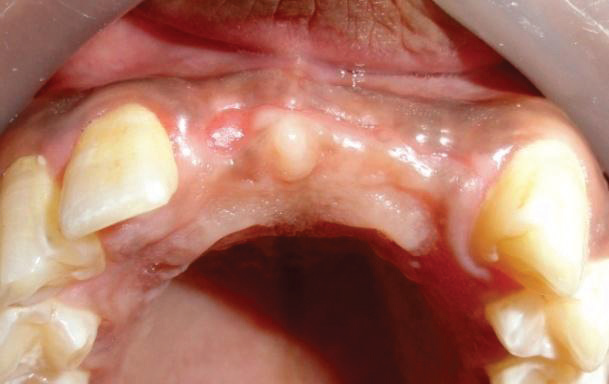
Intra-oral view

Implants placed irt 11 and 22
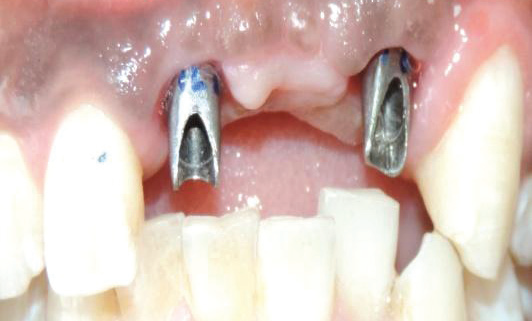
Prepared abutment placed intra-orally

Final prosthesis cemented
CASE 2

Preoperative View

Implants placed irt 31 and 42

Angled abutment placed on the model

Angled abutment placed intra-orally

Final prosthesis cemented
CASE 3

Preoperative View

Implants placed i.r.t 21
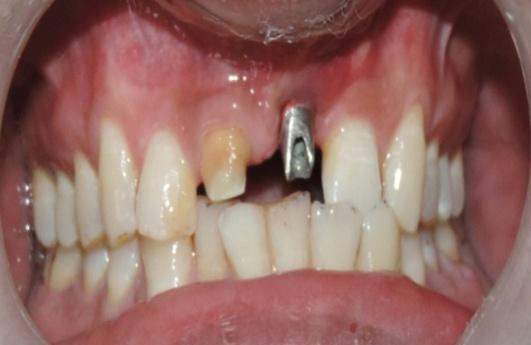
Customised abutment placed intra-orally

Final Prosthesis Cemented
CASE -4
Pre-Operative View

Pre-Operative View
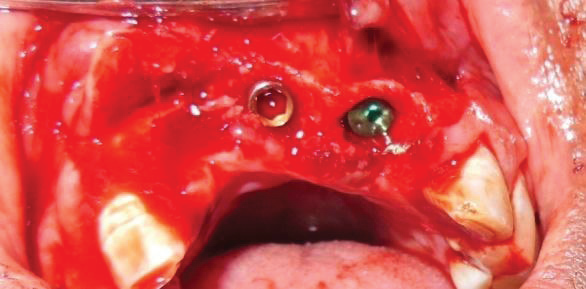

Immediate Implant placed w.r.t. 11, 21 and 12

PME Placed After Second Stage Surgery

Custom abutment wrt 11,12 &Prepared abutment wrt 21on model (facial view)

Abutments placed intra-orally

Final prosthesis cemented
SUMMARY
Customised prosthetic elements and abutments respect the dental anatomy and allow extremely precise seating of prosthesis on implants. Periodontal maintenance is therefore easier owing to easy access with a toothbrush because of the predetermined inter-dental spaces. The simplicity of the process saves a considerable amount of time: no major adjustments are required, the bridge is seated immediately, the occlusion is usually ideal, and greater accuracy can be achieved.
REFERENCES
- Angled Implant Abutments: A Practical Application of Available Knowledge John Cavallaro, Jr. and Gary Greenstein J Am Dent Assoc 2011;142;150-158.2.
- 73220A_Abutment_Brochure_2012.1_GB noble biocare.
- Fabrication of a customised implant abutment using CAD/CAM: A solution specific to each clinical case. Case report _ customised implant abutments Author_ Dr Thierry Lachkar, France.
- Design of a custom angled abutment for dental implants using computer-aided design and non-linear finite element analysis.Ting Wua,n, WenheLiao a, NingDai a, ChunboTang b Journal of Biomechanics43(2010)1941–1946.
- A Technique to Determine the Preferred Use of a Custom Abutment for an Implant Supported Crown Russell Wicks, D.D.S., M.S., Swati Ahuja, B.D.S., M.D.S., Vinay Jain, B.D.S., M.D.S. Journal of the Tennessee Dental Association 92-1.
- Implant adaptation of stock abutments versus CAD/CAM abutments: A radiographic and Scanning Electron Microscopy study. Davide Apicella, DDS, MS1 Annali di Stomatologia 2010; I (3-4): 9-13.
- Key stone dental prosthetic-manual www.keystonedental.com
- Review Article Rationale for the Use of CAD/CAM Technology in Implant Prosthodontics. International Journal of Dentistry Hindawi Publishing Corporation International Journal of Dentistry Volume 2013, Article ID 768121, 8 pages.
- http://www.dynamicabutment.com/producto_soluciones_protesicas/
Disclaimer from Guident
The views and opinions expressed in articles published in Guident are solely those of the authors and do not necessarily reflect the views of the editors, the editorial board or the publisher, Ivory India. Guident does not endorse any product, technique or treatment described. Clinical content is intended for qualified dental and medical professionals and is not a substitute for individual clinical judgement. Guident, its editors and the publisher accept no liability for any consequence arising from the use of information published in the journal.
How to cite this article
Dr. Manesh Lahori, Dr. Lanka Mahesh, Dr. Anant Sharma. Customized Dental Implant Abutments: A Simplified Approach to Enhance Esthetic and Soft Tissue Profile- Aseries of Case Reports. Guident. 2014 Jul;7(8). Available from: https://ivoryindia.in/articles/implantology/customized-dental-implant-abutments-a-simplified-approach-to-enhance-esthetic-and-soft-tissue-profile-aseries.html