Full Mouth Rehabilitation by Implant Supported Overdenture in Maxilla and Hybrid Fixed Prosthesis in Mandible: A Case Report
Jaipur, India
ABSTRACT
Difficulty in eating, speaking, ill-fitted denture and sore mouth syndrome has been affecting the quality of life among the elderly using dentures. The evolution from conventional denture to implant-supported prosthesis aids these patients with functional, normal healthy life along with esthetic benefits. The purpose of this study is to report a case of full-mouth rehabilitation using endosseous implants in maxilla and mandible loaded following the standard procedure. The surgery was performed chair-side under local anesthesia. Implant stability was sufficient (35 N/cm measured with a torque spring & ISQ was in range of 70-80) for all implants. Implants were loaded after 3 months and impression was taken using different viscosities of addition silicone. Vertical dimension for rest and occlusion were checked with wax occlusal rims and jig trial was done. Inter-occlusal records were made with the metal framework in place for the hybrid denture. The final restoration was tried and adjustments were made accordingly. Thereafter overdenture were placed in maxilla and hybrid denture in mandible to rehabilitate form, function of oral cavity along with also improving esthetics.
KEYWORDS: Full mouth rehabilitation, implant-supported fixed prosthesis, hybrid denture
INTRODUCTION
Dental implants offer a permanent replacement to missing and compromised tooth, thereby increasing functionality. A dental implant can be defined as a prosthetic device made of alloplastic material(s) implanted into the oral tissues beneath the mucosal and/or periosteal layer and within the bone which provides retention & support for a fixed or removable dental prosthesis, a substance that is placed into the jaw bone to support a fixed or removable dental prosthesis.1
Several parameters have been suggested to achieve successful rehabilitation using implants like adequate bone height, width and sagittal projection, adequate soft-tissue quantity and quality, preservation of buccal sulcus, inter-dental papillae and the gingival contour.2 “All-on-Four” technique was proposed for the rehabilitation in edentulous jaws. Although the use of only four implants for a complete fixed rehabilitation of the maxilla has been supported by clinical studies at short period.3,4,5 It has been suggested that using a larger number of implants for prosthetic treatment of the edentulous maxilla may be beneficial as the stresses on the majority of the implants were lower in comparison to the all-on-four planning.
The original Branemark surgical prosthetic protocol advocated placement of four implant fixtures for the restoration of resorbed maxilla and six implant fixtures on mandible which exhibit minimal-to-moderate resorption.6
The implant-supported fixed restoration (FP-3) restoration replaces the natural teeth crown and a portion of soft tissue. Basically, two approaches for FP-3 prosthesis exist: a hybrid restoration of denture teeth, acrylic and metal substructure, a porcelain-metal restoration.7 Here we have reported a case of implant supported overdenture in maxilla and hybrid fixed prosthesis in mandible retained on 3 endosseous implants in maxilla and 5 endo-osseous implant in mandible based on bone available.
CASE REPORT
Diagnosis and treatment planning
A 68-year-old male patient reported to us with chief complaint of inability to eat efficiently since last 8-10 months due to missing teeth in both upper and lower arches. Medical history was negative for hypertension, diabetes or any other systemic illness. Patient had no adverse habits of smoking. Patient wanted prosthesis for both arches to improve functionality as well as esthetics [Figure 1].

Figure 1: Frontal profile of patient
On clinical examination completely edentulous maxillary and mandibular arch were seen with sufficient inter-arch distance, adequate ridge height and quality in maxillary anterior, mandibular anterior and premolar region. Alveolar ridge was found to be atrophic depressed in both maxillary posterior region. A CBCT was performed for maxilla and mandible. After evaluation of CBCT 3 implants were planned to be placed in maxilla and 5 in mandible.
Surgical Phase
Patient was given basic antibiotic and analgesic an hour before the placement of implants. The implants were placed under local anesthesia 2% lignocaine with adrenaline 1:100000. The implants were placed with flapless technique. 3 endosseous implants were placed in maxilla in 13, 21, 24, region and 5 endosseous implants were placed in mandible in 31,33,35,43 and 45 region. A total of 8 implants were placed for full mouth rehabilitation in both arches and an implant stability of 35N/cm was achieved and an ISQ of 70-75 was noted for almost all implants. An IOPA was taken after maxillary implant placement to confirm angulation [Figure 2].
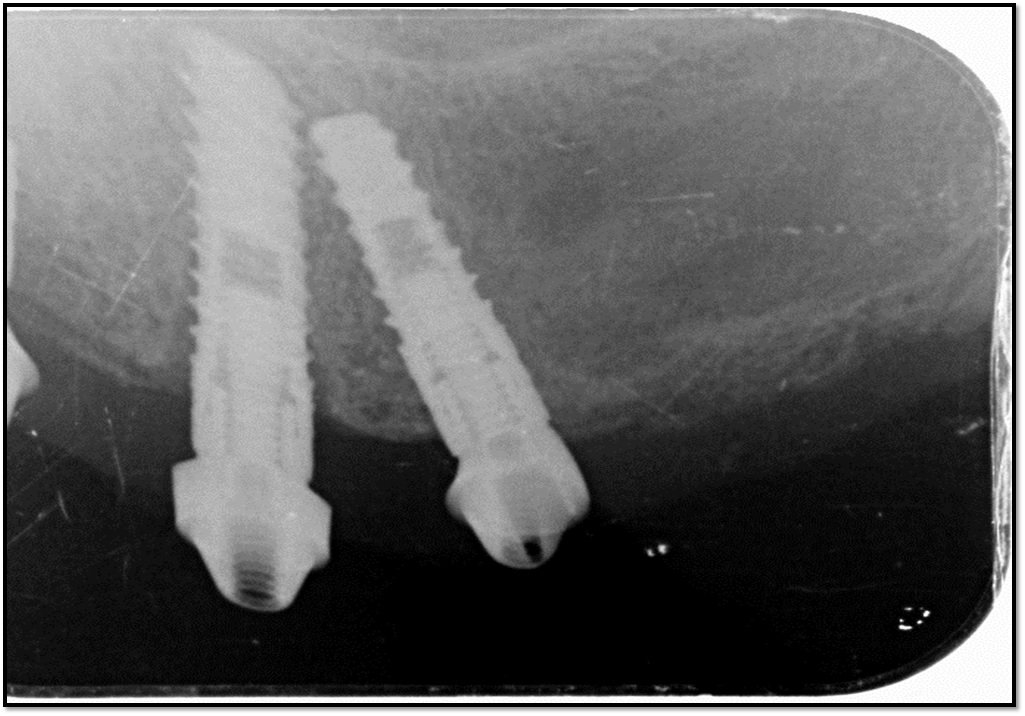
Figure 2: Implant position in posterior left maxilla.
Post operative care was administered with antibiotics, analgesics and mouthwash to patient. Patient was recalled after 3 months for loading of implants.
Prosthetic Phase
Patient was recalled after 3 months of waiting period for loading of implants. ISQ was checked for implants which ranged from 70 to 80. The open tray impression was tried in the mouth with impression copings taking care that the impression copings emerged to level with the windows made in the tray [Figure 3]. This permitted easy removal of the impression copings while ensuring that the copings are supported by sufficient amount of impression material. The impression of implants was made with addition silicone light body and putty consistency.

Figure 3: Maxillary impression with open tray method and metal framework
A jig trial was done and vertical dimension at rest and occlusion was checked and necessary adjustments were made. After this an impression was taken with framework in place [Figure 4,5]

Figure 4: Maxillary impression with metal framework in place

Figure 5: Metal framework in maxilla
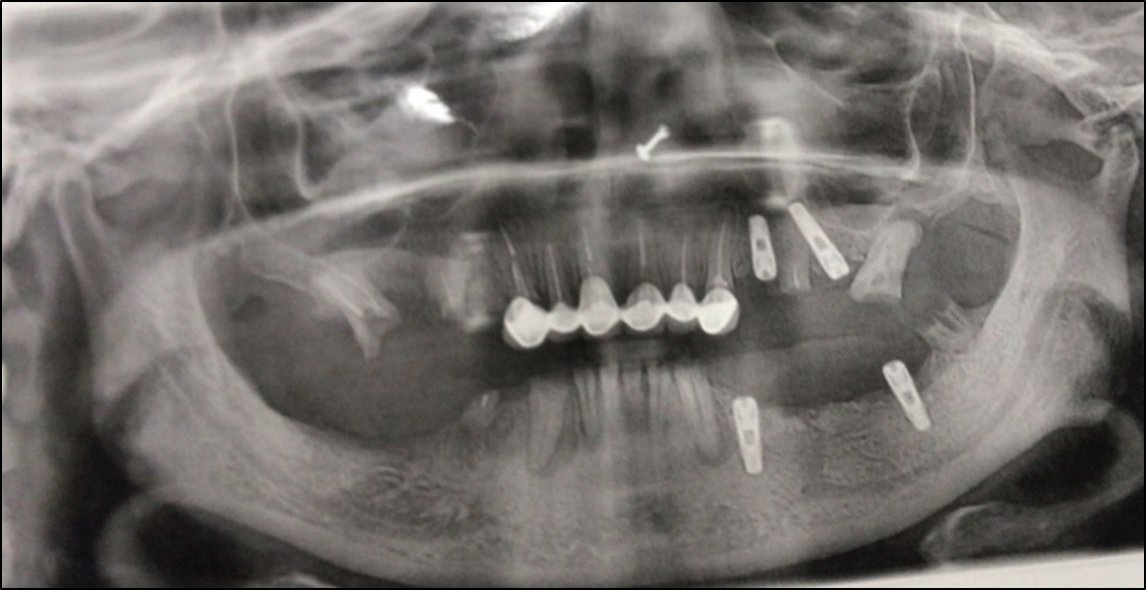
Maintaining the same vertical dimension at occlusion, metal framework was fabricated. Inter-occlusal records were made. An OPG was taken with metal framework in place [Figure-6].

Figure 6: OPG showing metal framework screwed in maxilla and mandible
After this the intaligo surface of maxillary denture was prepared to have retention rings to engage balls in bar to provide adequate retention and stability to overdenture. Hybrid denture was placed in mandible and occlussion was checked. Patient was asked to bite along with that occlusion was checked in centric relation, frontal and excursive movement. Necessary adjustments were made and final prosthesis were placed in both arches. The final prosthesis was screwed in lower arch using torque wrench and occlusion was checked. [Figure 7]

Figure 7: Maxillary overdenture
The prosthesis was well stabilized and in occlusion. Harmonious occlusion was noted in centric relation and during excursive movements. [Figure 8 A,B,C,D]

Figure 8: Intraoral pictures [A] frontal, [B] frontal excursive, [C] right lateral, [D] left lateral in occlusion
Patient was advised to maintain oral hygiene and a regular follow up annually.
DISCUSSION
Implant supported overdenture are a hallmark in prosthodontics, which helps in rehabilitating the patient oral health form and function of mastication. The implant-supported overdenture remains in place during mandibular movements which allows the tongue and peri-oral musculature to resume a more normal function.8,9,10,11
The original work of Branemark etal 12 carried out in 1977, whereby 4–6 vertical implants were placed within the anterior segment of edentulous maxilla and mandible cantilevered to accommodate full-arch fixed prosthesis. In the reported case we have placed 3 implants in maxillary and 5 in mandibular arch to achieve maximum stabilization and minimal cantilever to decrease stress over both arches and ensure a good retention and stabilization of implant retained prosthesis. Depending on positioning of posterior implant and the degree of jaw atrophy, the presence of cantilever may be inevitable which increases the risk of mechanical complications in the prosthesis (up to 50%).13,14,15 Thus, the presence of bone volume in the posterior jaw that allows the insertion of more implants (six implants in each arch) is beneficial to improve prosthetic support and to decrease cantilever length.13,14,15
In the reported case 3 endosseous implants have been placed in maxilla and 5 in mandible based on bone available. Conventional 2 –staged approach was used for implant placement with optimum osseointegration and stability. A close regular follow up has been advised to patient for maintenance of prosthesis. Aftercare and maintenance is important for the success of overdenture in a longer run. The patient must be advised for a regular follow up and oral hygiene maintenance along with prohibition of smoking and maintaining normal levels of blood glucose. Optimal surgical implant positioning is keystone for the success of implant supported prosthesis. An implant-retained overdenture requires careful treatment planning. Final placement of the implants should follow the principles of ideal implant parallelism and maximum initial stabilization, and path of placement and removal, good amount of torque and ISQ to ensure retention and stability of the implant.
CONCLUSION
Oral rehabilitation of partial or completely edentulous dental arches using dental implants is remarkable in rehabilitating form, function of oral cavity, ensuring patient comfort and satisfaction.An appropriate diagnosis and accurate implant planning are the keystone for success of implant retained rehabilitation. Certain factors are important while planning for implants like adequate bone density, soft-tissue quantity and quality, preservation of papillae and gingival contour. A close follow up helps in maintaining proper form, and function of implant supported prosthesis and keeping a check on stabilization and integration of implants with bone.
REFERENCES
- Ferro KJ. The Glossary of Prosthodontic Terms: Ninth Edition. J Prosthet Dent. 2017;117(5S):e1–e105.
- Guerrero C, Lopez P, Figueroa F. Three-dimensional alveolar distraction osteogenesis. In: Bell W, Guerrero C, editors. Distraction Osteogenesis of the Facial Skeleton. 1st ed. Hamilton (Canada): BC Decker; 2007. pp. 457–93.
- Lazari PC, Sotto-Maior BS, Rocha EP, de Villa Camargos G, Del Bel Cury AA. Influence of the veneer-framework interface on the mechanical behavior of ceramic veneers: A nonlinear finite element analysis. J Prosthet Dent. 2014;112:857
- Hasan I, Bourauel C, Mundt T, Heinemann F. Biomechanics and load resistance of short dental implants: A review of the literature. ISRN Dent. 2013;2013:424592.
- Corbella S, Taschieri S, Del Fabbro M. Long-term outcomes for the treatment of atrophic posterior maxilla: A systematic review of literature. Clin Implant Dent Relat Res. 2015;17:120–32.
- Brånemark PI, Engstrand P, Ohrnell LO, Gröndahl K, Nilsson P, Hagberg K, et al. Brånemark novum: A new treatment concept for rehabilitation of the edentulous mandible. Preliminary 12results from a prospective clinical follow-up study. Clin Implant Dent Relat Res. 1999;1:2–16.
- Bodine RL. Prosthodontic essentials and an evaluation of the mandibular subperiosteal implant denture. J Am Dent Assoc. 1955;51:654–64
- Naert I, Alsaadi G, Quirynen M. Prosthetic aspects and patient satisfaction with two-implant-retained mandibular overdentures: a 10-year randomized clinical study. Int JProsthodont. 2004;17:401–10.
- Timmerman R, Stoker GT, Wismeijer D, et al. An eight-year follow-up to a randomized clinical trial of participant satisfaction with three types of mandibular implant-retained overdentures. J Dent Res. 2004;83:630–3.
- Oetterli M, Kiener P, Mericske-Stern R. A longitudinal study on mandibular implants supporting an overdenture: the influence of retention mechanism and anatomic-prosthetic variables on periimplant parameters. Int J Prosthodont. 2001;14:536–42.
- Lee Cornell K, Agar John R. Surgical and prosthetic planning for a two-implant–retained mandibular overdenture: A clinical report. J Prosthet Dent. 2006;95:102–3.
- Brånemark PI, Engstrand P, Ohrnell LO, Gröndahl K, Nilsson P, Hagberg K, et al. Brånemark novum: A new treatment concept for rehabilitation of the edentulous mandible. Preliminary results from a prospective clinical follow-up study. Clin Implant Dent Relat Res. 1999;1:2–16.
- Maló P, Nobre Md, Lopes A. The rehabilitation of completely edentulous maxillae with different degrees of resorption with four or more immediately loaded implants: A 5-year retrospective study and a new classification. Eur J Oral Implantol. 2011;4:227–43.
- Maló P, Rangert B, Nobre M. All-on-4 immediate-function concept with brånemark system implants for completely edentulous maxillae: A 1-year retrospective clinical study. Clin Implant Dent Relat Res. 2005;7(Suppl 1):S88–94.
- Malo P, de Araujo Nobre M, Lopes A. The use of computer-guided flapless implant surgery and four implants placed in immediate function to support a fixed denture: Preliminary results after a mean follow-up period of thirteen months. J Prosthet Dent. 2007;97:S26–34.
Disclaimer from Guident
The views and opinions expressed in articles published in Guident are solely those of the authors and do not necessarily reflect the views of the editors, the editorial board or the publisher, Ivory India. Guident does not endorse any product, technique or treatment described. Clinical content is intended for qualified dental and medical professionals and is not a substitute for individual clinical judgement. Guident, its editors and the publisher accept no liability for any consequence arising from the use of information published in the journal.
How to cite this article
Dr. Gaurav Gupta, Dr. D.K. Gupta, Dr. Neelja GuptaWisdom Dental Clinics ®. Full Mouth Rehabilitation by Implant Supported Overdenture in Maxilla and Hybrid Fixed Prosthesis in Mandible: A Case Report. Guident. 2023 Oct;16(11). Available from: https://ivoryindia.in/articles/implantology/full-mouth-rehabilitation-by-implant-supported-overdenture-in-maxilla-and-hybrid-fixed-prosthesis-in-mandible.html