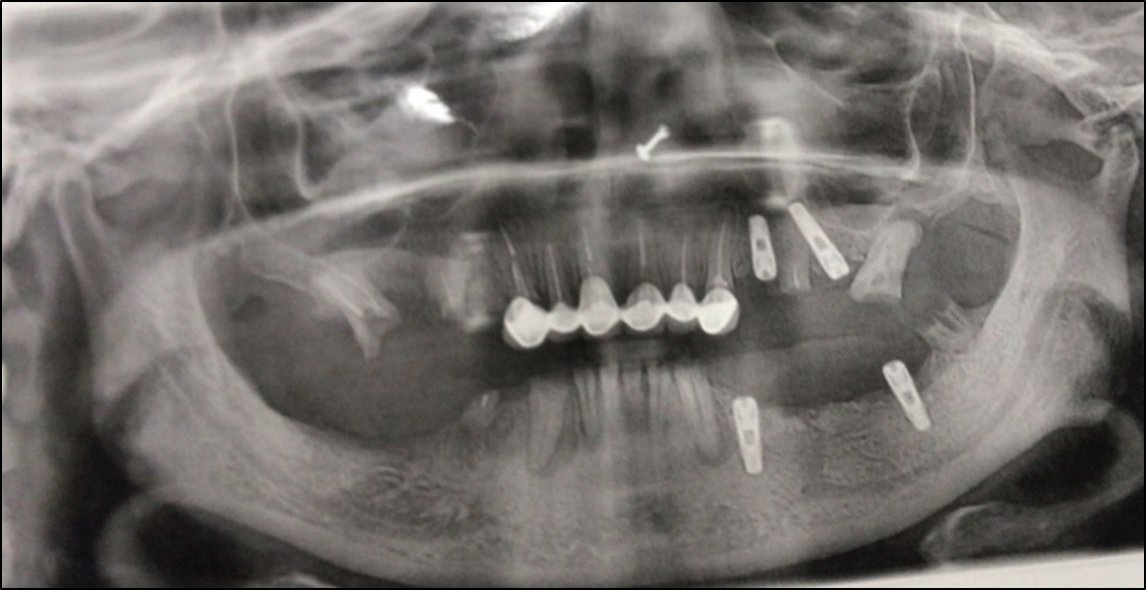
Why No Periimplantitis in Periodontitis Patients
V. K. Dental India Pvt. Ltd. #302, V K Plaza, BSK 3rd Stage, 4th Phase, 7th Block, Bangalore
INTRODUCTION
Periimplantitis associated with conventional dental implants is now called the disease of the millennium. Today dental implants are becoming obsolete treatment for both partially and fully edentulous condition. The success of these implants in long term does not merely depend on the initial success of osseointegration but the presence of healthy soft tissue around the implants achieved by minimum oral hygiene maintenance even in periodontitis patients.
In today’s era of high longevity, associated increased co morbidities, and high expectations from the patient in the era of information explosion, the success is defined by rehabilitating patients with immediate fixed permanent prosthesis with minimum maintenance.
With conventional dental implant, susceptibility to infection, beginning with peri mucositis leading to peri implantitis and further progression to implant loss also leaves behind hard and soft tissue destruction. With re invention of smooth surface single piece cortical implants periimplantitis has become the thing of the past.
INCIDENCE AND PREVALENCE OF PERI IMPLANTITIS IN CONVENTIONAL IMPLANTS
The prevalence of peri-implant mucositis and peri-implantitis has ranged from 19 to 65% and 1 to 47%, respectively . A systematic review revealed that the frequency of peri-implant mucositis was 63.4% on the patient level and 30.7% on the implant level. The prevalence of peri-implant mucositis at the patient level varied between 1.1 and 80%
Approximately 1/3rd to 1/5th of the population who had implants suffered from peri implantitis. With increasing number of patients opting for implant treatment, peri implantitis finally leading to implant loss creates a huge financial burden.
ETIOLOGY OF PERI IMPLANTITIS
Peri-implantitis is a site specific disease which is a result of biofilm-induced inflammation in the soft tissue that subsequently triggers a host response, with tissue degradation . The first step in Peri- implantits is initiated by the accumulation of bacterial in biofilm. Peri-implant inflammation develops when microbes activate the host’s innate and adaptive immune responses.
RECENTLY another etiological factor beinging considered is peri implantitis as non “infectious disease”, but rather the result of natural changes of the bone’s morphology in response to implant such as a decrease in convexity of the outer surface of the bone and subsequently a decrease in concavity of the inner bone.
Risk factors and indicators for conventional implants:
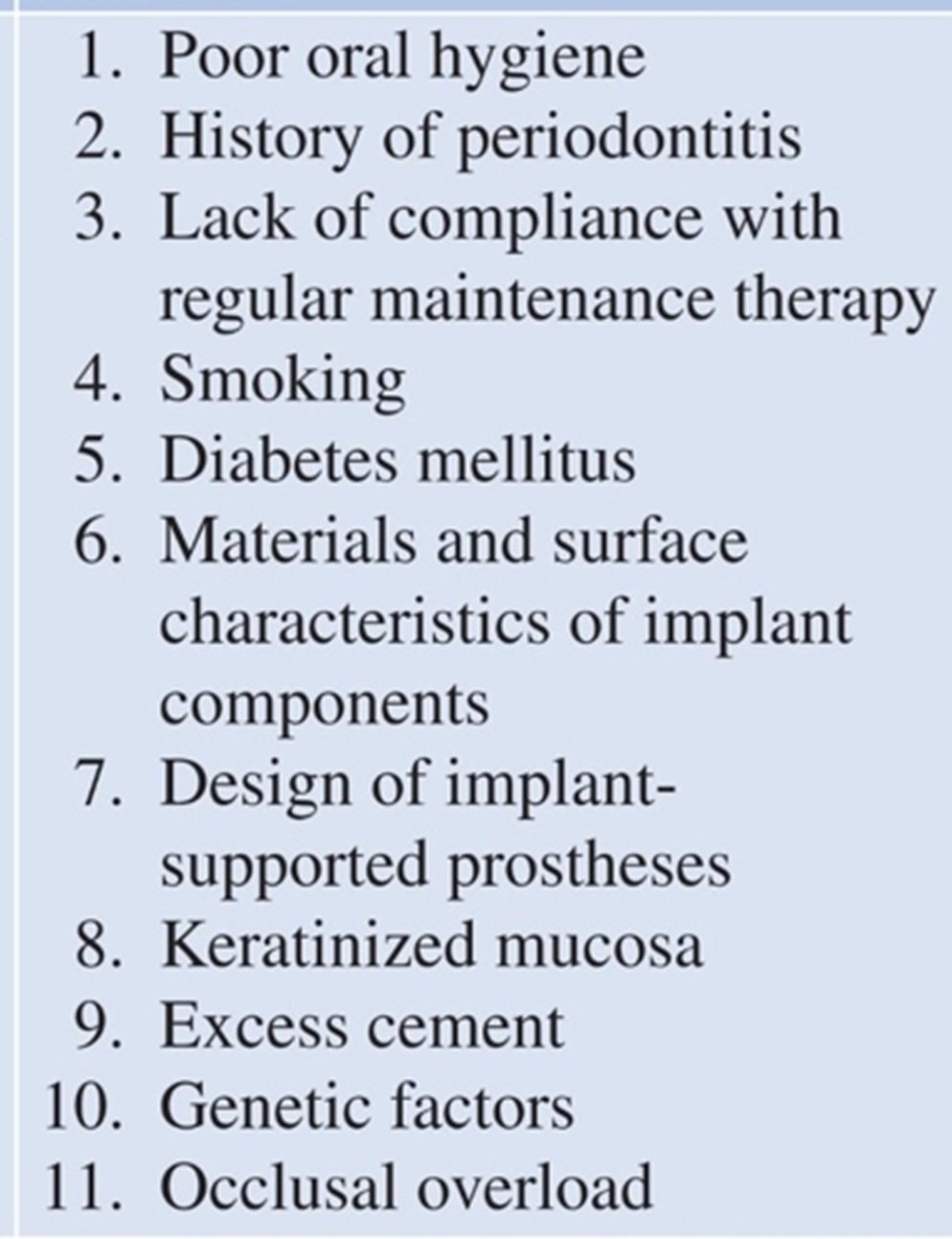
Table 1
Until today, there is no single solely responsible etiological factor for the periodontal disease associated with teeth and also with dental implants.
TREATMENT OPTIONS TRIED TILL RECENTLY FOR PERI IMPLANTITIS
- Administration of antibiotics alone
- Mechanical debridement with or without systemic antibiotic treatment
- Mechanical debridement with or without localized drug delivery and chlorhexidine oral rinses
- Mechanical debridement combined with LASER decontamination
- Surgical debridement
- And more recently Surgical debridement with guided bone regeneration (GBR) for preparation of bony and soft tissue defects
In spite of all the above treatment modalities applied, peri implantitis reappeared in 100% of the cases (Esposito et all, Heitz-Mayfield & Mombelli ).
Various studies evaluated the difficulty in removing periodontal pathogens from the mouth states “the repopulation of treated periodontal pockets by microbial pathogens may also come from several oral reservoirs, including epithelium and lamina propria of the pocket wall and epithelium of the buccal mucosa, dorsum of the tongue, tonsillar crypts, and saliva”.
In conclusion, new treatment modalities need to be evaluated using long term RCT to identify predictable and successful treatment of periimplantitis
MAJOR REASONS FOR FAILURE OF 2 PIECE CONVENTIONAL IMPLANTS
- Rough surface: rough surface of the implants increases bacterial adhesion leading to more periimplantitis . The higher the surface roughness, the higher the mean periimplantitis rate
- Large diameter : because of large diameter of conventional implants wider osteotomies have to be prepared leading to decrease thickness of marginal bone. On functional loading of these implants crestal bone is further lost in turn leading to peri implantitis
- 2 piece conventional two-piece implants create a micro gap between abutment and the implant leading to increased submucosal bacterial load in turn increasing the chances of peri implantitis
CASE REPORT-1

Fig 1

Fig 2

Fig 3
CASE REPORT-2
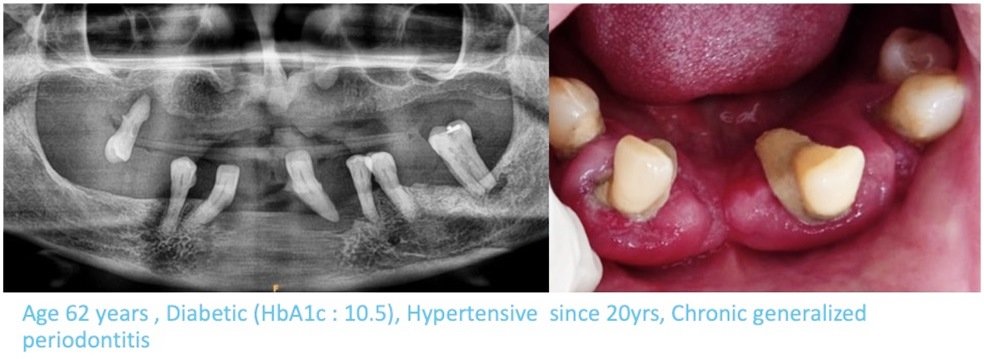
Fig 1

Fig 2

Fig 3
CASE REPORT-3

Fig 1: Chronic generalized periodontitis

Fig 2
DISCUSSION
Special design feature of smooth surface mono implants:
- Smooth implants: These smooth implants are highly polished which prevents the adhesion of bacteria to the surface of the implant. Decrease in microbial adhesion prevents biofilm from becoming pathogenic , as increase in number of bacteria which is the first step in itself is inhibited.
- Single piece: As the abutment is attached to the implant there is no submucosal micro gap formation, further decreasing the bacterial colonization and the sub mucosal bacterial load. Since this is a single piece implant there is no micro motion between the abutment and the implant.
- Thin Neck : The thin highly polished neck which emerges transmucosally provides decreased surface area for bacterial colonization. Along with this thin neck narrow emergence profile created like a platform switch allows maximum preservation of the crestal cortical bone at the site of bacterial attack and maximum remodeling. The maximum amount of crestal cortical is preserved by key hole drills.
- Long shaft: The entire length of the implant does not take the load. The shaft only connects the apical load bearing threads to the abutment. Because of this the shaft heals uneventfully in the socket as if nothing is present. The bendability of shaft is of great advantage as it allows the clinician to reach the best bone i..e 2nd and the third cortical and once anchored can be bent to adjust intraorally to the prosthetic advantage.
These smooth single piece corticle implants immediately loaded with a thin emerging neck and a reduced diameter of thread size creats plateform switch .This plateform switch creats an adequate epithelial seal necessary for the bone to heal perfectly achieving osseointegration.
- Apical threads: Sharp self-cutting threads are present only apically. These highly sharp threads help in incising the dense mineralized infection free cortical bone. The threads are moved away from the site of maximum remodeling and also the site of bacterial attack i..e the first cortical making these smooth surface cortical implants peri implantitis free.
- Histological studies have proved that the supra crestal soft tissues around one-piece implants are similar to the gingival soft tissues surrounding healthy teeth .

Fig 1: Smooth surface cortical implant
CONCLUSION
Even today the search for reliable and successful treatment for peri implantitis is still missing. Instead the reinvention of smooth surface cortical implants which are peri implantitis free is the current way forward. The simple yet sophisticated design of the smooth surface cortical implants which can be used in periodontitis patients with multiple co morbidities and no bone situations is the simple solution.
The minimally invasive flapless, key hole technique with immediate loading offers a perfect solution for almost all patients looking for immediate and permanent fixed rehabilitation.
Disclaimer from Guident
The views and opinions expressed in articles published in Guident are solely those of the authors and do not necessarily reflect the views of the editors, the editorial board or the publisher, Ivory India. Guident does not endorse any product, technique or treatment described. Clinical content is intended for qualified dental and medical professionals and is not a substitute for individual clinical judgement. Guident, its editors and the publisher accept no liability for any consequence arising from the use of information published in the journal.
How to cite this article
Dr. Veerendrakumar SC., Dr. Geetha Priyadharshini. Why No Periimplantitis in Periodontitis Patients. Guident. 2023 Oct;16(11). Available from: https://ivoryindia.in/articles/implantology/why-no-periimplantitis-in-periodontitis-patients.html